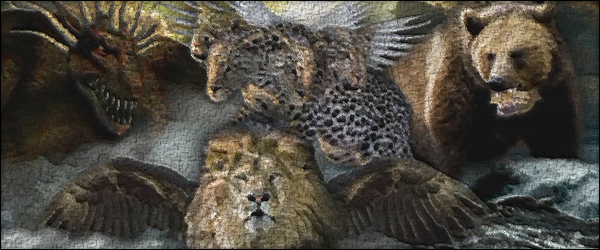
The prophet Daniel was a young man when Nebuchadnezzar invaded Judah, destroyed Jerusalem, and Solomon's temple in the seventh century BC. He and many other Hebrew people were taken as exiles to Babylon (modern-day Iraq). The prophecies recorded in his book concern the Hebrew people, Jerusalem, and the land of Israel. They cover an expanse of time from when he was alive right down to our day and the Second Coming of Jesus.
Wikipedia Links on the four great empires brought to light in the book of Daniel:
Neo-Babylonian Empire /
Medo-Persian Empire /
Alexander's Greek Empire /
Roman Empire
|
Nebuchadnezzar's Dream: Daniel Chapter 2
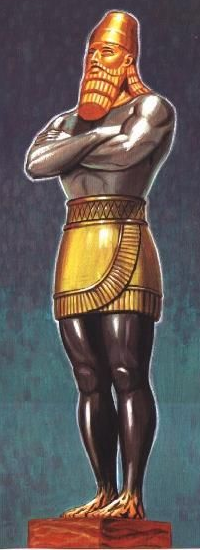
Your Majesty looked, and there before you stood a large statue - an enormous, dazzling statue, awesome in appearance.The head of the statue was made of pure gold, its chest and arms of silver, its belly and thighs of bronze, its legs of iron, its feet partly of iron and partly of baked clay. While you were watching, a rock was cut out [of a mountain], but not by human hands. It struck the statue on its feet of iron and clay and smashed them. Daniel 2:31-34 You [Nebuchadnezzar] are that head of gold. Daniel 2:38 |
|
|||
Symbolism 101:
|
|||
|
|||
Identification of the Little Horn:
But the court will sit, and his power will be taken away and completely destroyed forever. Then the sovereignty, power and greatness of all the kingdoms under heaven will be handed over to the holy people of the Most High. Daniel 7:26-27 Men of Galilee, they said, why do you stand here looking into the sky? This same Jesus, who has been taken from you into heaven, will come back in the same way you have seen him go into heaven. Acts 1:11 |
|||
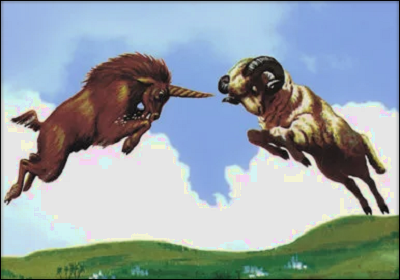
| Daniel's Vision of a Ram and a Goat: Daniel 8
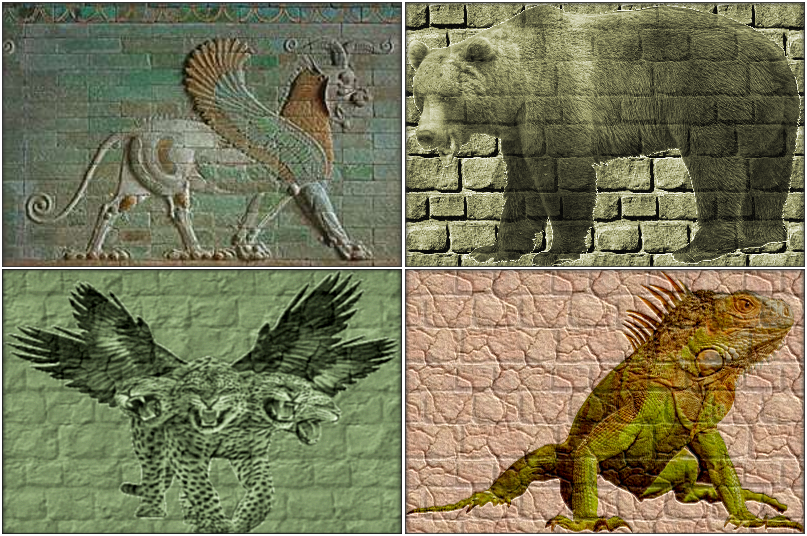
In the vision I was beside the Ulai Canal. I looked up, and there before me was a ram with two horns... One of the horns was longer than the other but grew up later. Suddenly a goat with a prominent horn between its eyes came from the west... It came toward the two-horned ram... I saw it attack the ram furiously,... striking the ram and shattering its two horns... the goat knocked it to the ground and trampled on it. Daniel 8:2-7
|
|
||
|
|||
| Another Little Horn:
Out of one of them [the four horns] came another horn, which started small but grew in power to the south and to the east and toward the Beautiful Land. Daniel 8:9
Son of man, he [Gabriel] said to me, understand that the vision concerns the time of the end. Daniel 8:17 The dragon gave the beast his power and his throne and great authority. Revelation 13:2 |
|||
| The Seventy 'Sevens': Daniel 9
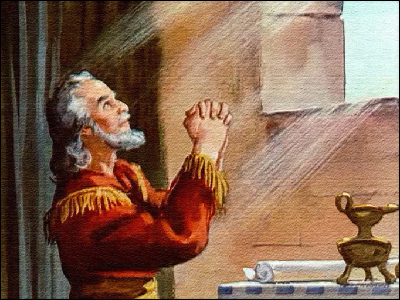
I turned to the Lord God and pleaded with him in prayer and petition, in fasting, and in sackcloth and ashes. Daniel 9:3
Seventy 'sevens' are decreed for your people and your holy city to finish transgression, to put an end to sin, to atone for wickedness, to bring in everlasting righteousness, to seal up vision and prophecy and to anoint the Most Holy Place. Daniel 9:24 Know and understand this: From the time the word goes out to restore and rebuild Jerusalem until the Anointed One, the ruler, comes, there will be seven 'sevens,' and sixty-two 'sevens.' It will be rebuilt with streets and a trench, but in times of trouble. Daniel 9:25 |
|
- The good news of the seventy 'sevens' finds its fulfillment in the coming of the Annointed One, the Messiah, first promised in Genesis 3:15.
- The decree in question is the one given to Ezra and issued by Artaxerxes, king of Persia, in the year 457 BC. This is the starting point of the seventy 'sevens'.
- The seventy 'sevens' are divided into three distinct periods:
- Seven 'Sevens' = 49 days or years
- Sixty-Two 'Sevens' = 434 days or years
- One 'Seven' = 7 days or years.
- The first division of 49 years is the time given for the completion of the work of restoration.
- The second division of 434 years culminates to about AD 26. This may be about the time when Jesus was baptized in the Jordon river, anointed by the Holy Spirit, and afterward began his public ministry.
- The most widely accepted date for Jesus' crucifixion is AD 33. 490 years added to 457 BC equals AD 33.
Wiki Link: Crucifixion of Jesus - This then is the culmination of the seventy 'sevens' and fulfills the objectives stated for it in verse 24. Jesus became the sacrificial Lamb of God for the salvation of the Earth.
- The verse above suggests there was an agreement between the Jewish authorities and Rome, which was broken with the outbreak of hostilities.
- Jerusalem and the Temple were destroyed by the Roman General Titus in AD 70 as a result of the First Jewish Revolt against the Roman Empire ( AD 66–73).
After these things, during the reign of Artaxerxes king of Persia, Ezra son of Seraiah... came up from Babylon... to Jerusalem in the seventh year of King Artaxerxes. Ezra 7:1-7
After the sixty-two 'sevens,' the Anointed One will be put to death and will have nothing. (or... death, but not for himsel) Daniel 9:26(p1)
The people of the ruler who will come will destroy the city and the sanctuary. The end will come like a flood: War will continue until the end, and desolations have been decreed. He will confirm a covenant with many for one 'seven.' In the middle of the 'seven' he will put an end to sacrifice and offering. And at the temple {or... at the wing) he will set up an abomination that causes desolation, until the end that is decreed is poured out on him. Daniel 9:26(p2)-27
In the third year of Cyrus king of Persia, a revelation was given to Daniel (who was called Belteshazzar). Its message was true and it concerned a great war. The understanding of the message came to him in a vision.
- Daniel's vision of a heavenly being:
I looked up and there before me was a man dressed in linen, with a belt of fine gold from Uphaz around his waist. His body was like topaz, his face like lightning, his eyes like flaming torches, his arms and legs like the gleam of burnished bronze, and his voice like the sound of a multitude. Daniel 10:5-6
- The heavenly being's message to Daniel:
Now I have come to explain to you what will happen to your people in the future, for the vision concerns a time yet to come. Daniel 10:14
A mighty king will arise, who will rule with great power and do as he pleases. After he has arisen, his empire will be broken up and parceled out toward the four winds of heaven. It will not go to his descendants, nor will it have the power he exercised, because his empire will be uprooted and given to others. Daniel 11:4
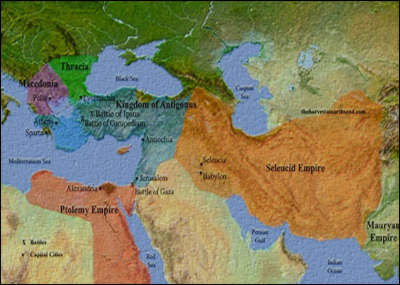
- The history of this conflict has its origins beginning with the breakup of Alexander's Empire following his death in 323 BC. The empire was divided up among four of his generals:
- Antigonus - Asia Minor
- Cassander - Greece & Macedonia
- Ptolemy - Egypt
- Seleucus - Southwest Asia
- This prophecy covers a very long history from its beginning down to the very end of time to Jesus' Second Coming.
- The main participants during the first three centuries:
- Ptolemaic Kingdom of Egypt: The King of the South.
- Antigonid Empire: The first King of the North.
- Seleucid Empire: The second King of the North.
- Roman Empire: The third King of the North.
- There were political alliances as well as military confrontations between the kings of the north and the kings of the south for control of Alexander's empire. And between these competing powers at the frontline of contested territory lay the Holy Land.
Wars of the Diadochi / The Syrian Wars / Roman Egypt - The Kings of the South, symbolized as Ptolemaic Egypt, represent geopolitical powers that feature materialistic ideals, polytheistic religions, and are historical enemies of God's people, notably the nation of Israel and Christianity that arose from it.
- This looks forward to the time of the end when "the time of wrath is completed." The description of this king who exalts himself is identical for the following:
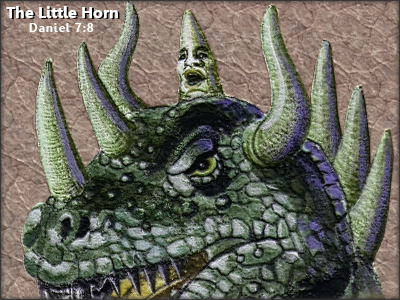
- The little horn of Daniel 7: He will speak against the Most High and oppress his holy people... As I watched, this horn was waging war against the holy people and defeating them.
- The little horn of Daniel 8: He will destroy those who are mighty, the holy people... He will cause deceit to prosper, and he will consider himself superior... and take his stand against the Prince of princes.
- The leopard-like beast of Revelation 13: The beast was given a mouth to utter proud words and blasphemies... It was given power to wage war against God’s holy people and to conquer them.
- The two-horned beast of Revelation 13: It exercised all the authority of the first beast on its behalf, and made the earth and its inhabitants worship the first beast, whose fatal wound had been healed.
- The scarlet beast of Revelation 17: They [the ten horns on the beast] have one purpose and will give their power and authority to the beast. They will wage war against the Lamb, but the Lamb will triumph over them because he is Lord of lords and King of kings.
- The king that exalts himself is the end-time antichrist as are the little horns of Daniel, The leopard beast of Revelation 13, and the scarlet beast of Revelation 17:
- Considers himself superior.
- Is boastful and speaks blasphemies against God.
- Puts himself forward as the object of worship.
- Persecutes God's faithful people.
- At Jesus' Second Coming, the end-time antichrist forms an alliance with the false prophet and the kings of earth but are defeated. Revelation 19:19-20
The king will do as he pleases. He will exalt and magnify himself above every god and will say unheard-of things against the God of gods. He will be successful until the time of wrath is completed, for what has been determined must take place. He will show no regard for the gods of his ancestors or for the one desired by women, nor will he regard any god, but will exalt himself above them all. Daniel 11:36-37
