All the entities listed below brought to light in the prophetic books of Daniel and The Revelation foretells of the future end-time antichrist that precedes the Second Coming of the Messiah. The imagery and symbolism are different but the identification of the entity is one and the same.
While I was thinking about the horns [the ten horns on the fourth beast], there before me was another horn, a little one, which came up among them; and three of the first horns were uprooted before it. This horn had eyes like the eyes of a human being and a mouth that spoke boastfully. Daniel 7:8
Then I wanted to know the meaning of the fourth beast, which was different from all the others... I also wanted to know about the ten horns on its head and about the other horn that came up... As I watched, this horn was waging war against the holy people and defeating them, until the Ancient of Days came and pronounced judgment in favor of the holy people of the Most High, and the time came when they possessed the kingdom. Daniel 7:20-22
- The fourth beast represents the Roman Empire and is analogous with the legs of iron on Nebuchadnezzar's statue.
- The ten horns represent the divisions of Europe after the fall of the Western Roman Empire (476 AD) and are analogous with the feet of iron and clay on Nebuchadnezzar's statue.
- The little horn that arises later upon the head of the fourth beast represents the future end-time antichrist that mirrors in many ways a power similar to that of the pagan Roman Empire.
- This is proven by its actions as it boasts of its greatness and becomes a persecutor of God's people, and the fact that its power is taken away with the coming of the son of man. Daniel 7:13
The goat became very great, but at the height of its power the large horn was broken off, and in its place four prominent horns grew up toward the four winds of heaven. Out of one of them came another horn, which started small but grew in power to the south and to the east and toward the Beautiful Land... It set itself up to be as great as the commander of the army of the Lord... It prospered in everything it did, and truth was thrown to the ground. Daniel 8:8-12
He will cause deceit to prosper, and he will consider himself superior. When they feel secure, he will destroy many and take his stand against the Prince of princes. Yet he will be destroyed, but not by human power. Daniel 8:25
- The goat represents the Greek Empire (Daniel 8:21) and the large horn represents Alexander the Great. The large horn was broken upon his untimely death in 323 BC.
- The four horns that replaced the large horn represent the Greek Empire divided up among four of Alexander's generals:
- Antigonus - Asia Minor
- Cassander - Macedon
- Ptolemy - Egypt
- Seleucus - Southwest Asia
- Another horn arises from one of the four, which begins small but grows in power, represents the emerging Roman Empire which succeeded the Greek Empire.
- The 'Beautiful Land' (Palestine) came under the dominion of Rome by the first century BC. Rome ended the practice of Judaism with the destruction of Jerusalem and the second temple in 70 AD.
- The Western Roman Empire came to an end in 456 AD but, just like the little horn of Daniel 7, this horn reappears as a successor at the end of time.
- Its arrogance leads him in the end to a fatal confrontation with the Prince of princes, a fitting description of Jesus at his Second Coming.
- This connects the little horn with the scarlet beast of Revelation 17 when it and the ten horns "wage war against the Lamb, but the Lamb will triumph over them." Revelation 17:14
The king will do as he pleases. He will exalt and magnify himself above every god and will say unheard-of things against the God of gods. Daniel 11:36
- This entity is the culmination that began with the break up of Alexander's empire following his death and the resultant conflicts between the kings of the north and the kings of the south.
- The text is not clear if the king who exalts himself originates from one of these or is a new power on the stage that is opposed by one or both of these kings.
- The one thing the text is clear about is that this entity is a further and expanded revelation of the end-time antichrist.
- He denies the deity of any god and puts himself forward as the only god and worthy of worship.
- He bestows honor and places his trust on military technology and weapons of war, thus making it the hallmark of his religion.
- He has no hesitation in attacking nations he considers his enemies and he will reward those who acknowledge him.
- This will eventually result in the great time of trouble for the people on earth and, specifically, God's faithful.
- He will be successful until the time of wrath is completed, which occurs in the final confrontation at Jesus' Second Coming. "Yet he will come to his end, and no one will help him." Daniel 11:45
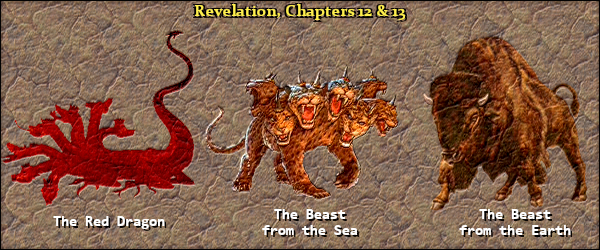
A great sign appeared in heaven: a woman clothed with the sun, with the moon under her feet and a crown of twelve stars on her head. She was pregnant and cried out in pain as she was about to give birth. Then another sign appeared in heaven: an enormous red dragon with seven heads and ten horns and seven crowns on its heads. Revelation 12:1-3
The great dragon was hurled down - that ancient serpent called the devil, or Satan, who leads the whole world astray. He was hurled to the earth, and his angels with him. Revelation 12:9
Then the dragon was enraged at the woman and went off to wage war against the rest of her offspring - those who keep God’s commands and hold fast their testimony about Jesus. Revelation 12:17
- Here is introduced the first mention of the dragon in the book of Revelation in connection with the woman seen by John as described in the text above. The description connects her with Jacob whom God renamed Israel. Genesis 32:28
- This vision reveals Satan's desire to destroy Israel and thereby prevent the coming of the promised savior which was given by God in the Garden of Eden. Genesis 3:15
- This attack having failed, the dragon then resorts to destroy the message of salvation in Christ to this day.
- The dragon has seven heads, ten horns and seven crowns on its heads. This description is nearly identical to that given for the first beast of Revelation 13 and the scarlet beast of Revelation 17.
- The seven heads on the dragon represent nations that act as adversaries of God's people, past, present, and future.
- The ten horns, unlike the heads, are symbolic of powers that exist contemporaneously. They represent both divisions of power as with the breakup after the fall of the Western Roman Empire, and the final union of said powers prior to Jesus' Second Coming. Daniel 7:24, Revelation 17:12
- The presence of crowns suggests entities that are empowered to rule, while the lack of crowns suggests those that are not yet empowered.
The dragon stood on the shore of the sea. And I saw a beast coming out of the sea. It had ten horns and seven heads, with ten crowns on its horns, and on each head a blasphemous name... The dragon gave the beast his power and his throne and great authority... People worshiped the dragon because he had given authority to the beast, and they also worshiped the beast and asked, "Who is like the beast? Who can wage war against it?" Revelation 13:1-8
- A beast in biblical prophecy symbolizes powers that have been or will be hostile towards God's faithful on earth, and were the Biblical enemies of the nation of Israel.
- It is safe to assume that the dragon entity thus introduced is instrumental in the appearance of the beast that arises from the sea.
- The sea symbolizes the populous region around the Mediterranean from which arise the great civilizations and empires of the ancient world.
- There is a twofold identification for the dragon entity:
- It is "that ancient serpent called the devil, or Satan, who leads the whole world astray." Revelation 12:9
- It also represents all the human agencies that have been employed by the devil in its attack on God's creation, his faithful people, and the promised Messiah.
- The physical description of the dragon given in Revelation 12:3 is nearly identical to that of the beast from the sea and the scarlet beast of Revelation 17 in that they all have seven heads and ten horns.
- The physical description of this beast makes a strong connection with the four beasts that Daniel saw in a vision as recorded in chapter 7 of his book.
- Resembled a leopard: Greece.
- Feet like those of a bear: Medo-Persia.
- Mouth like that of a lion: Babylonia.
- Ten horns on its head: Rome.
- Prior to Daniel's time there were two nations recorded in the historical books of the Bible that became enemies and conquerors of Israel: Egypt and Assyria. These two in addition to those listed above are symbolized by the seven heads on the beast culminating in the future end-time beast.
- Egypt
- Assyria
- Babylonia
- Medo-Persia
- Greece
- Rome
- The End-Time Beast
- The beast that arises from the sea is in fact the end-time appearance of the beast and thus incorporates all the beast entities of the past.
- Just as the little horns of Daniel 7 and 8, the beast that arises from the sea stands in opposition to the God of heaven putting itself forward as a god and the object of worship, which explains why it is guilty of blasphemy.
- Who dealt this fatal wound and how was it healed? The Roman Empire when its religion was pagan was a persecutor of Jews and Christians. She ceased to be such when Christianity became the state religion in the fourth century AD.
- It is the sixth head, therefore, that bore the scar of a fatal wound. The healing of the fatal wound brings about the reemerging end-time beast prior to Jesus' Second Coming.
- The healing of the fatal wound is revealed in the next discussion by the arrival of the beast that arises from the earth.
- The forty-two months is the same period of time given to the little horn power that arises later on the head of Daniel's fourth beast. Daniel 7:25
- Some expositors believe this prophetic period equates to three and one half years of literal time or 1,260 years in prophetic time. Whichever it is, the significance of this period points to a time of great distress and persecution for God's people.
- The ten horns symbolically represent the divisions of Europe after the fall of the Western Roman Empire in 456 AD.
- The crowns on the ten horns symbolize the time when they are empowered as kings and become united in purpose with the end-time beast. Revelation 17:12
- The scarlet beast revealed in chapter 17 is the same as the beast that arises from the sea. The former is shown as it existed in John's time, while the later as the beast that "yet will come."
- In the final battle we find the beast, the false prophet, and the kings of earth confronting the Lamb of God and the army of heaven but they are defeated. Revelation 17:14, Revelation 19:19-20
The beast I saw resembled a leopard, but had feet like those of a bear and a mouth like that of a lion. Revelation 13:2
One of the heads of the beast seemed to have had a fatal wound, but the fatal wound had been healed. The whole world was filled with wonder and followed the beast. Revelation 13:3
The beast was given a mouth to utter proud words and blasphemies and to exercise its authority for forty-two months. Revelation 13:5
It was given power to wage war against God’s holy people and to conquer them. And it was given authority over every tribe, people, language and nation. All inhabitants of the earth will worship the beast - all whose names have not been written in the Lamb’s book of life Revelation 13:7-8
Then I saw a second beast, coming out of the earth. It had two horns like a lamb, but it spoke like a dragon. It exercised all the authority of the first beast on its behalf, and made the earth and its inhabitants worship the first beast, whose fatal wound had been healed.
Revelation 13:11-12
- Just as water and earth are two different states of matter, so the the beast from the earth symbolizes a power that differs from the sea beast, possibly in several ways.
- The second beast is not the end-time antichrist, but from the text above it is shown to work on behalf of the beast from the sea, which is why it is included in this discussion.
- Having lamb-like horns but the voice of a dragon strongly suggests that this entity is a deceiver, which would corroborate its other identification as the false prophet. Revelation 19:20
- Causing fire to come down from heaven hearkens back to the prophet Elijah and the miracle on Mount Carmel (1 Kings 18:38). Here the second beast performs the same sign to deceive the people of earth.
- It is the second beast, therefore, who by deception is instrumental in the healing of the fatal wound which causes the world into worshiping the first beast.
- These last two points strongly suggest that the second beast that arises from the earth is a false religious entity that works on behalf of the beast from the sea.
- Setting up an image of the beast strongly suggests the introduction of idolatry in the worship of the first beast. Giving life and breath to the image of the beast suggests that it is not like other idols made of stone or wood. This image may symbolize a separate agency created to work in cooperation with the second beast.
- The image of the beast commands the people of earth to bow down to it on pain of death. The worship of idols in ages past was how people would show devotion to their gods.
- It is the second beast that works on behalf of the first beast, so that identifies the first beast as that which the people of earth are marked with.
- The mark of the beast is stated to be the name of the beast or the number of its name. That number can be calculated from the name of the beast but scripture doesn't give us the name.
- In the Bible the number seven primarily symbolizes completeness, fullness, and divine perfection, thus 666 may represent sinful humanity.
- The mark of the beast is placed on the forehead or the right hand of those who receive it. This signifies loyalty to the beast by thought or deed. Those who refuse to receive the mark are denied basic goods and services.
And it performed great signs, even causing fire to come down from heaven to the earth in full view of the people. Because of the signs it was given power to perform on behalf of the first beast, it deceived the inhabitants of the earth. Revelation 13:13-14
It ordered them to set up an image in honor of the beast who was wounded by the sword and yet lived. The second beast was given power to give breath to the image of the first beast, so that the image could speak and cause all who refused to worship the image to be killed. Revelation 13:14-15
It [the second beast or the image] also forced all people, great and small, rich and poor, free and slave, to receive a mark on their right hands or on their foreheads, so that they could not buy or sell unless they had the mark, which is the name of the beast or the number of its name. This calls for wisdom. Let the person who has insight calculate the number of the beast, for it is the number of a man [Or is humanity’s number]. That number is 666. Revelation 13:16-18
Then I saw the beast and the kings of the earth and their armies gathered together to wage war against the rider on the horse and his army. But the beast was captured, and with it the false prophet who had performed the signs on its behalf... The two of them were thrown alive into the fiery lake of burning sulfur. Revelation 19:19-20
And I saw an angel coming down out of heaven, having the key to the Abyss and holding in his hand a great chain. He seized the dragon... and bound him for a thousand years. He threw him into the Abyss, and locked and sealed it over him, to keep him from deceiving the nations anymore until the thousand years were ended. Revelation 20:1-3
This is the final destiny of the dragon, the antichrist, and the false prophet which occurs at Jesus' Second Coming.
